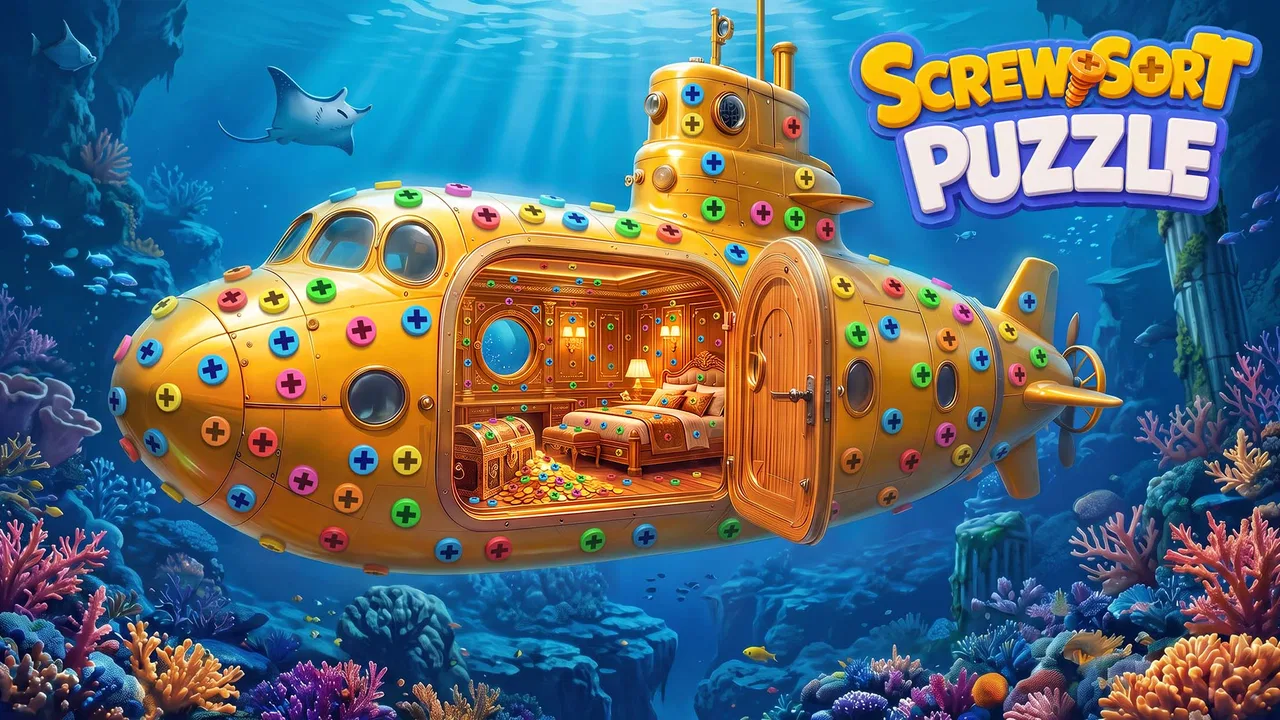
Screw Sort Puzzle: Pin Jam 3D
- 4.8
- Rating
- 10.00M
- Installs
- Free
- Price

 Analysis by App-foxy
I went into Screw Sort Puzzle: Pin Jam 3D expecting a simple mobile puzzle, and that is exactly what it delivers: a board crowded with screws, nuts, bolts, and layered pieces that need to be removed in a sensible order. The first action is easy to understand. I tap a screw, watch the piece shift, and immediately start looking for the next safe move. That direct connection between touch and result is the game’s strongest quality.
This is a free puzzle game from Astrasen Global, aimed at Everyone and available on devices running Android 6.0 or later. It has built a sizeable audience, with more than five million installs and an average rating of 4.8 from roughly ninety-six thousand ratings. Those figures do not automatically make a game good, but they fit my experience: the basic idea is accessible, the controls are quick to learn, and a short session is easy to start whenever I have a spare minute.
How the screw puzzle loop feels in practice
I find the appeal of this screw puzzle loop lies less in tapping quickly than in noticing what each removal changes. A useful way to approach a crowded board is to pause after every move and check which routes remain open, rather than treating each newly reachable screw as the next instruction. That small shift makes the choices feel more deliberate and sets up a closer look at how the game’s current version fits into its simple, focused design.
You May Also Like

 Blood Strike: 2.5 Anniversary
Blood Strike’s Loadouts Turn Every Drop Into a Tactical Gamble
A close look at Blood Strike’s custom loadouts: how fast access to signature weapons reshapes its battle royale rhythm, rewards preparation, and narrows the gap between fights.

 Pandora - Music & Podcasts
Pandora’s Music Is Easy to Start, but Harder to Recover
Pandora’s strength is its low-effort path from a seed to a station. Its weak spot is how much confidence it asks you to place in connection, setup, and quiet recovery.

 8 Ball Pool
 Is Built on Rivalries, Rematches, and Routine
A close look at the rivalries, rematches, shared routines, and unanswered safety questions that turn a quick pool match into a persistent mobile community.

 Samsung Music
’s Quiet Strength Is Playing What You Already Own
Its reach comes less from spectacle than from dependable access to a personal library. That simplicity is both the app’s strongest retention engine and its ceiling.

 AccuWeather: Weather Radar
AccuWeather Review: A Quick, Clear Forecast for Everyday Decisions
For everyday plans, the best forecast is the one you can understand quickly. AccuWeather makes rain timing, radar, and local conditions easy to act on, with a few trade-offs.

 Hill Climb Racing
Why Hill Climb Racing Still Turns Crashes Into One More Run
A tiny car, a bumpy hill and one more upgrade: Hill Climb Racing keeps resurfacing because its simple chaos makes every near-miss feel personal.
More From Our News Desk



The first move is simple, but the board asks for patience
Each puzzle begins with a visual problem rather than a written one. Pieces overlap, pathways are blocked, and the useful screw is not always the one that looks most obvious. I tap to remove or reposition what the board allows, then study the new opening. The game does not need a complicated tutorial to explain its central action because the board itself teaches the rule: choose a move, see what it frees, and plan the next move around that change.
That simplicity is helpful when I am playing on a phone with one hand. I do not need to remember a long control scheme, and I can understand the state of a level at a glance. The tactile theme also makes ordinary puzzle actions feel more concrete. Instead of moving abstract tiles, I am clearing hardware from a structure, which gives every successful tap a visible purpose.
The important detail is that a move is rarely isolated. Removing one screw can expose another piece, create a useful gap, or reveal that I have opened the wrong route. This makes the game more thoughtful than a simple tapping exercise. I often pause after a successful move, not because the controls are difficult, but because the new arrangement changes the whole order of the board.
Feedback keeps the short sessions moving
The feedback rhythm is built around small confirmations. A correct action changes the arrangement immediately, and that visual change tells me whether I am making progress. The board becomes less crowded, a blocked section opens, or a part that looked inaccessible becomes available. I do not have to wait for a long transition to understand the result, which is important in a puzzle designed for quick play.
This rhythm creates a pleasant sequence: tap, observe, reassess, then tap again. When I am solving carefully, the game feels almost like tidying a physical mechanism. The satisfaction comes from seeing a complicated cluster become more readable. The reward is not only the completion screen; it is also the gradual disappearance of visual clutter during the level itself.
There is a useful distinction between a move that looks productive and one that actually improves the position. A screw may be easy to reach but still leave the important obstruction untouched. I learned to judge moves by what they expose, not simply by how quickly they remove something. That habit is one of the better reasons to play this particular puzzle: it encourages short-term planning without demanding the heavy concentration of a traditional strategy game.
Why the next move keeps feeling tempting
The game’s reward structure works because progress is visible. Clearing a difficult section produces an immediate sense of order, and finishing the board gives a natural stopping point. Then the next puzzle becomes attractive because I want to see what kind of arrangement it presents. The loop does not depend on a story or a large cast of characters. It depends on the small pleasure of turning a crowded layout into an empty one.
For me, the strongest reward arrives when I solve a board through a route that was not obvious at the beginning. I may first identify a screw that seems trapped, then realize that another piece must be cleared from the opposite side. When the final obstruction disappears, the level feels earned rather than automatic. That moment is more satisfying than simply tapping every available object in any order.
The game is also well suited to interrupted play. If I have a short wait before an appointment or a few minutes during a commute, I can begin a puzzle without committing to a long campaign. A completed board gives me a clean reset point. That makes it more convenient than puzzle games that require extended concentration or punish the player for stepping away.
The reset is part of the appeal, not just an ending
After a level is cleared, the board’s tension disappears and the experience resets around a new arrangement. That reset matters because the pleasure comes from solving a fresh physical problem, not from repeating one fixed pattern. I am not merely trying to improve a score on the same board; I am preparing to inspect another cluster of fasteners and decide what should come out first.
At the same time, the reset can feel abrupt if I prefer a deeper sense of progression. This is a puzzle loop focused on individual challenges, so players looking for a rich narrative, character development, or a large strategic campaign may find the structure lightweight. The game is strongest when I want a series of compact problems, not when I want a world that remembers every decision.
One practical habit helps me avoid careless resets: before making a risky tap, I scan the board for pieces that depend on the current arrangement. I look for narrow openings, blocked screw heads, and sections where one removal might make another route impossible. This quick inspection takes only a moment, but it reduces the feeling that a failed attempt came from guessing. It also turns the reset into a learning step, because I return to the next board with a clearer idea of how the pieces interact.
Where the difficulty feels fair
The game is approachable because the objective remains visible even when the solution is not. I can usually tell what needs to be removed, but I still have to work out the order. That is a good balance for casual players. Someone who rarely plays puzzle games can understand the goal immediately, while an experienced player can look for efficient sequences and avoid wasting moves.
There is also a difference between visual complexity and genuine difficulty. A crowded board may look intimidating, yet the correct first action can simplify it quickly. Conversely, a smaller arrangement can be awkward when several pieces compete for the same opening. I appreciate that distinction because it prevents me from judging a level only by its appearance.
My main limitation with this format is repetition. Once I have spent a long stretch solving similar screw-and-bolt layouts, the central action can lose some of its freshness. The game works best in bursts. I would rather play several focused puzzles, put the phone down, and return later than continue until every board starts to blend together.
Small habits that make solving more reliable
I found three approaches especially useful. First, I check the edges and corners before touching the central cluster. Outer pieces often reveal which sections are genuinely connected and which are merely overlapping visually. Second, I identify the most restricted opening and protect it until I know what depends on it. A move that creates space is not always good if it removes the only route to another piece.
Third, I treat every newly exposed screw as information rather than an instruction. Just because it becomes available does not mean it should be removed next. Sometimes it is better to leave that option in place while clearing a different obstruction. This is a subtle but important trade-off: speed can make the board look cleaner, while restraint can preserve more solving options.
These habits are not complicated enough to turn the game into a serious logic simulator, but they add depth to the touch controls. They also answer a common question a new player may have: should every available screw be removed immediately? In my experience, no. The safest move is the one that improves access while keeping several future choices open.
Who will enjoy it, and who should look elsewhere
I would recommend this game to anyone who likes visual sorting, light mechanical puzzles, and short sessions with a clear beginning and end. It is particularly comfortable for players who want an easy-to-read objective but still enjoy thinking about order and consequences. It can also work well as a low-pressure break because the core interaction is understandable within seconds.
I would be more cautious recommending it to someone who needs constant novelty, a story-driven reason to continue, or a demanding competitive system. Players who prefer word puzzles, number logic, or elaborate spatial manipulation may find the screw theme too narrow after extended play. A more traditional brain-training title may be a better choice if the goal is varied problem types rather than one focused mechanical loop.
It is also worth considering the free-to-play model before installing. The game is free to download, while optional in-app purchases range from $0.99 to $99.99 per item. That broad range makes it sensible to approach the game as a no-cost casual experience first and decide for yourself whether any optional spending feels worthwhile. I would not install it expecting a premium puzzle experience with every element designed around a single upfront payment.
Device expectations and everyday use
The stated minimum requirement is Android 6.0, so the game is positioned to work on a wide range of Android phones and tablets. In everyday use, I would still choose a screen large enough to distinguish overlapping parts comfortably. The controls are simple, but tiny visual details matter when several screws sit close together, and a cramped display can make a careful puzzle feel more awkward than it really is.
A realistic use case is a short evening break after finishing a task. I can open the game, solve one board while waiting for tea to steep, and stop when the layout clears. Another player might use it during a brief commute or while waiting for an appointment. The important point is that the loop has a natural reset: I do not need to remember a complicated narrative state, and I can return later to a new puzzle mindset.
The current version is 1.470, and the game’s broad audience suggests that it has found a comfortable place among casual puzzle players. I would still judge it by the moment-to-moment experience rather than by popularity. Its appeal comes from the clarity of the action and the satisfying change from crowded to cleared, not from a promise that it will replace every other type of puzzle game.
My verdict on the complete action-feedback-reward cycle
The loop is easy to describe but effective to play: I choose a screw, receive immediate visual feedback, gain access to another part of the structure, clear the board, and then start again with a fresh arrangement. The reason another session begins is simple: the previous solution leaves me curious about whether the next board will require the same patience or a different order of attack.
What I like most is the balance between physical-looking objects and logical decision-making. The theme gives the taps a purpose, while the puzzle design asks me to think beyond the next obvious removal. What holds it back is the possibility of repetition and the fact that players seeking deeper progression may want more than a chain of standalone challenges.
Overall, I see this as a strong free puzzle for short, focused play. Its 4.8 average rating and large install base are consistent with its accessible design, but my recommendation is more specific: try it if you enjoy clearing visual clutter through careful sequencing. Skip it if you need a story, broad genre variety, or a highly competitive endgame. For the right player, the simple act of unscrewing one piece, watching the board open, and deciding whether to continue is enough to make the next session feel worthwhile.
FAQs for Screw Sort Puzzle: Pin Jam 3D
01What is the main objective of Screw Sort Puzzle: Pin Jam 3D?
Screw Sort Puzzle: Pin Jam 3D challenges players to strategically sort and organize screws by color using a series of pins. The goal is to clear each level by ensuring all screws are correctly grouped, enhancing problem-solving skills and providing a satisfying sense of achievement as you progress through increasingly complex puzzles.
02Is Screw Sort Puzzle: Pin Jam 3D free to play?
Yes, Screw Sort Puzzle: Pin Jam 3D is free to download and play. However, it may offer in-app purchases for additional features, ad removal, or hints. Players can enjoy the full core gameplay experience without spending any money, but optional purchases can enhance the gaming experience.
03What age group is Screw Sort Puzzle: Pin Jam 3D suitable for?
Screw Sort Puzzle: Pin Jam 3D is suitable for players of all ages, from children to adults. Its intuitive gameplay mechanics make it accessible for younger players, while the increasingly challenging levels ensure that even seasoned puzzle enthusiasts will find it engaging and mentally stimulating.
04Does Screw Sort Puzzle: Pin Jam 3D require an internet connection?
No, Screw Sort Puzzle: Pin Jam 3D can be played offline, allowing you to enjoy the game without an internet connection. This makes it ideal for travel or situations where connectivity may be limited. However, some features, like ads removal or in-app purchases, may require an internet connection.
05What platforms is Screw Sort Puzzle: Pin Jam 3D available on?
Screw Sort Puzzle: Pin Jam 3D is available for both Android and iOS devices. You can download it from the Google Play Store for Android or the Apple App Store for iOS. Ensure your device meets the minimum system requirements for optimal performance and a smooth gaming experience.
Pros
- Engaging 3D graphics enhance gameplay.
- Challenging levels keep users hooked.
- Simple controls
- easy to learn.
- Frequent updates add new features.
- Offline play available
- no internet needed.
Cons
- Ads can be intrusive during play.
- In-app purchases may be pricey.
- Some levels feel repetitive.
- Occasional bugs disrupt gameplay.
- Limited customization options.

Screw Sort Puzzle: Pin Jam 3D
Gallery